
Tower Rush is considered one of the most balanced turbo games in the Galaxsys lineup, thanks to its RTP ranging from 96.12% to 97%. The medium volatility provides moderate risk while offering decent potential for wins. The maximum win is capped at ₹8,25,000, with a minimum bet of ₹0.75 and a maximum bet of ₹8,300. The game also uses Provable Fairness technology, allowing players to verify the fairness of the results.
Best choise to play Tower Rush for Indian Players:
-
 Welcome PackUp to ₹150,000Get a 500% bonus + 430 free spins.
 -
 Welcome BonusUp to ₹150,000First deposit bonus, get 100% bonus and 70 free spins
 -
 Weekly CashbackUp to 30% cashback, claimable weeklyGet up to 30% weekly cashback on your casino losses.
 -
 100% Welcome BonusUp to ₹30,000Get an exclusive 100% welcome bonus up to ₹30,000 for new players
 -
 Welcome Bonus125% with a deposit of ₹250This is a welcome bonus offering a 125% instant games bonus with a deposit of ₹250
 -
 500% Welcome BonusUp to ₹30,000Get a 500% bonus on your first two deposits. Register today and start playing!
 -
 700% Welcome BonusUp to ₹30,000Get a massive 700% bonus when you sign up and start playing Tower Rush
 -
 700% Welcome BonusUp to ₹30,000Build the tower and catch the win with a massive 700% bonus on your first deposit
Game Features
| Developer | Galaxsys |
| Release Date | December 19, 2024 |
| Genre | Turbo Game / Crash-Arcade |
| RTP | 96.12% – 97% |
| Volatility | Medium (dynamic, depends on the number of floors) |
| Min. Bet | ₹0.75 |
| Max. Bet | ₹8,300 |
| Max. Win | ₹8,25,000 |
| Min. Multiplier | x1 |
| Max. Multiplier | x100 |
| Difficulty | Medium |
Tower Rush Game Rules
The gameplay in Tower Rush involves progressively increasing the multiplier. Before starting a round, the player selects the bet amount, ranging from ₹0.75 to ₹8,300. Next, you need to click the Build button to place the first floor of the tower. Each new level adds a multiplier, which, if successfully placed, increases the potential payout.
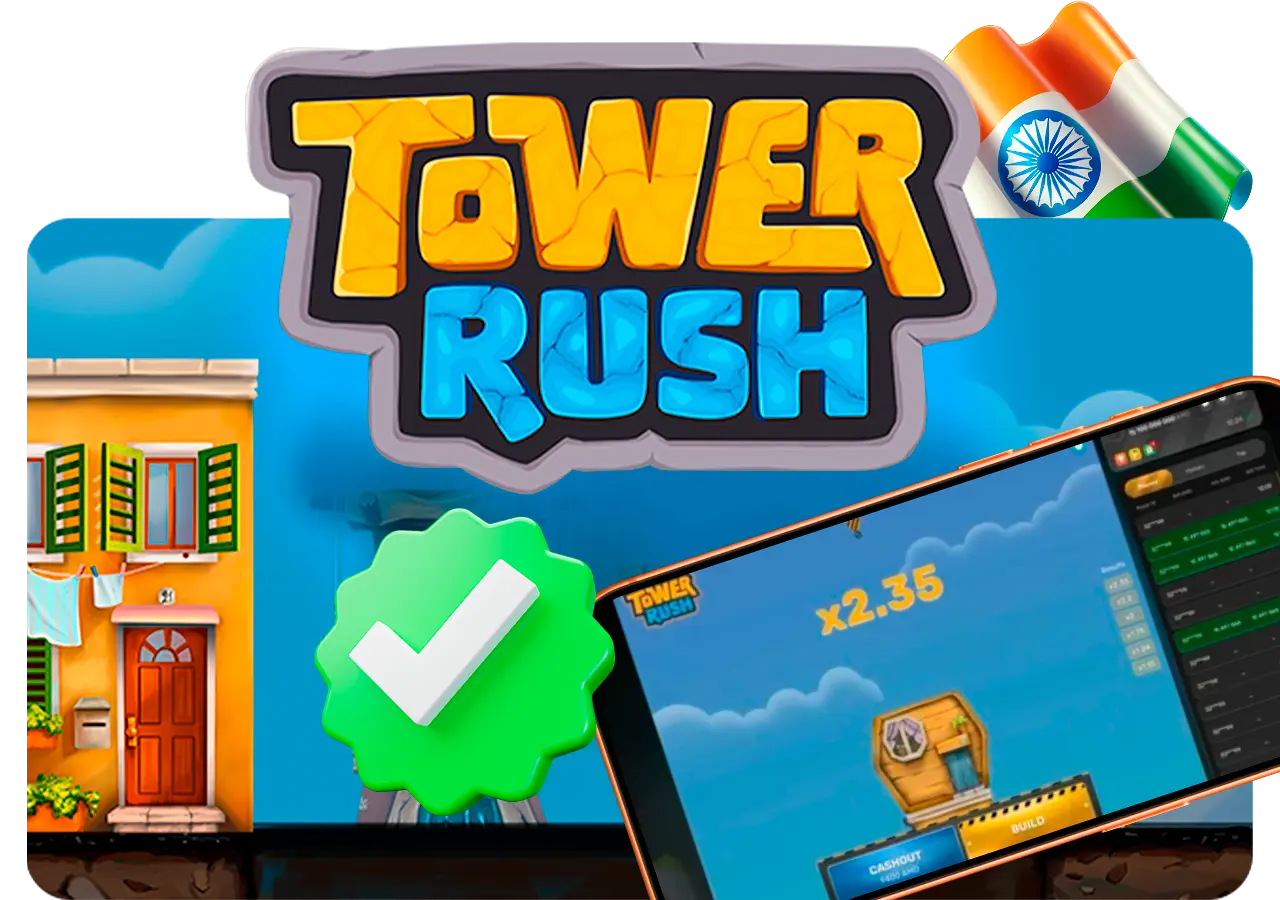
After placing a floor, two actions are available: “Cashout” and “Build”.
- Cashout: End the round and lock in the payout, multiplied by the current multiplier.
- Build: Continue construction, increasing the potential future win but also raising the risk of losing the bet. If the floor collapses, the invested funds are lost.
Tower Rush includes 3 bonus floors that are triggered randomly:
- Frozen Floor: Freezes the multiplier and increases the likelihood of successfully placing the next level.
- Temple Floor: Boosts the multiplier by adding a bonus.
- Triple Build: Allows the placement of 3 floors consecutively, significantly speeding up the growth of the potential win.
The game uses a Random Number Generator (RNG) to generate random outcomes. Players can verify fairness by using the hash system. If players do not want to risk real money, they can try the demo version.
How to Play Tower Rush for Real Money
Lorem ipsum dolor sit amet, consectetur adipiscing elit, sed do eiusmod Tower Rush is designed for fast-paced yet thoughtful gameplay. To play Tower Rush for real money, you need to choose your bet size, ranging from ₹0.75 to ₹8,300. After that, click the “Build” button to place the first floor of the tower. Each successfully placed block increases the overall payout multiplier.
The player can stop the game at any time by selecting “Cashout”. In this case, the payout is calculated using the formula: bet x current multiplier. If the tower collapses, the round ends, and the invested funds are lost. To speed up the process, there is an “x2” button. It doubles the bet and is suitable for gamblers using risky strategies like Martingale.
All actions, from starting the game to cashing out the earnings, happen instantly, with no delays. Thanks to the Provable Fairness technology, each round is cryptographically verified, ensuring that there is no intervention from the operator or third parties.
Tower Rush is not a reel-based slot but a crash game, where fast reflexes and sound calculation are key. Every click determines the outcome: the higher the tower, the higher the multiplier and the risk.
Tower Rush Demo
The developer, Galaxsys, offers a complete demo version of Tower Rush, which mirrors the original game. In this version, virtual coins are used, and the multipliers and probabilities are identical to those in the real-money game. If a player chooses to try Tower Rush for free, they can:
- Experiment with the betting mechanics and understand how the multiplier system works.
- Observe how often bonus features such as Frozen Floor, Temple Floor, and Triple Build appear.
- Develop a risk management strategy and see how it impacts gameplay.
The free version doesn’t require any registration and can be accessed directly through web browsers like Chrome, Safari, and Edge, as well as on mobile devices running iOS and Android. Thanks to HTML5 technology, the game runs smoothly without needing any additional software installation.
The demo mode is a valuable tool, as it allows players to see how the multipliers evolve in real time. They can track how quickly the multiplier increases and at what point the risk becomes too high. This approach helps minimize mistakes when transitioning to real-money bets.
How to Win in Tower Rush: Game Tips
To understand how to win in Tower Rush, the first thing you should do is play the demo version and get familiar with how the game works. It’s important to note that each new floor increases the multiplier, but also raises the risk of collapse. The best strategy is to identify the optimal moment to cash out, when the multiplier has already provided a profit but the risk hasn’t become too high yet. Here are some practical tips:
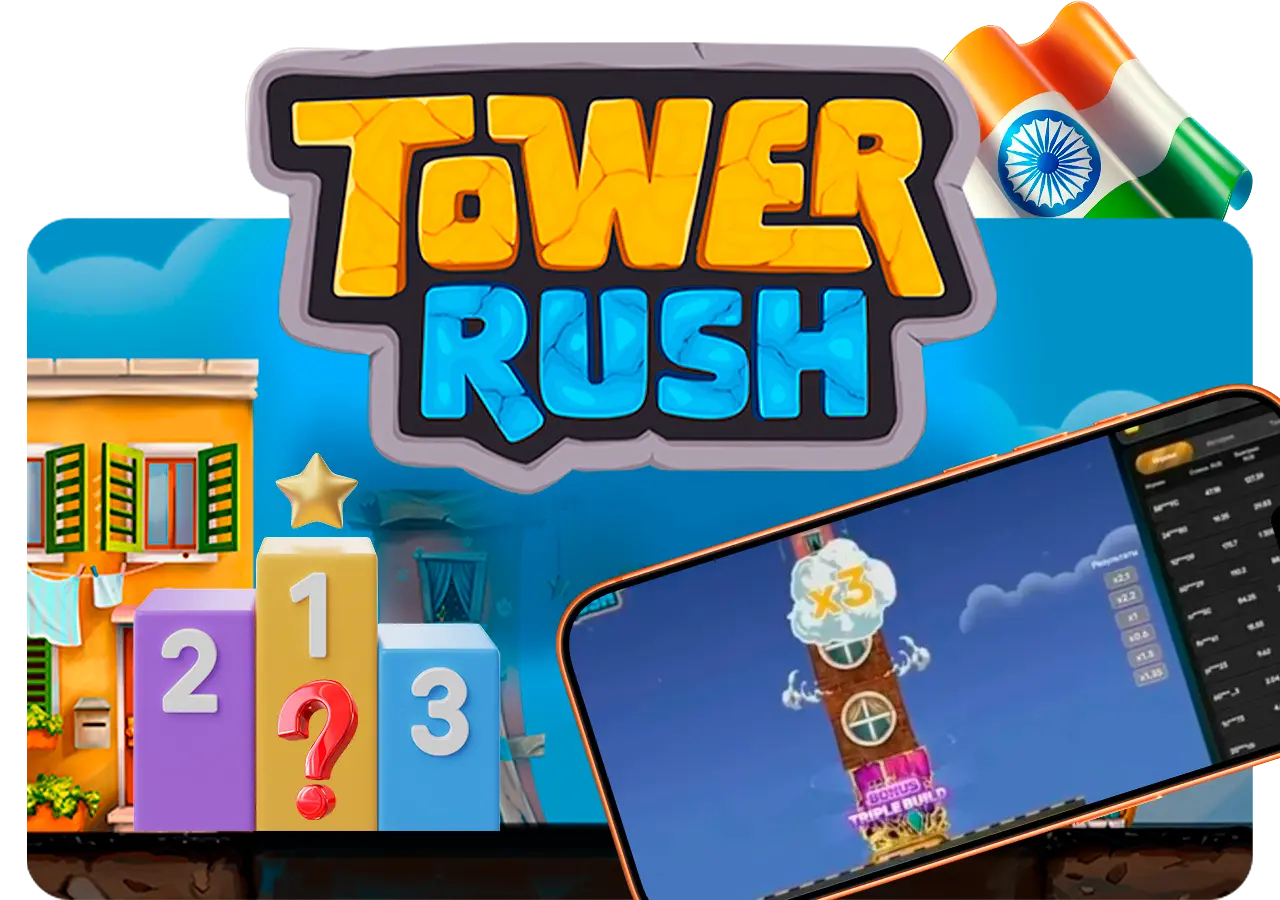
- Start with small bets. The minimum bet is ₹0.75. During your first sessions, focus on understanding the frequency of failed floors and how the bonus features behave.
- Use the “x2” button. This strategy works well for those who use a gradual increase in bets (similar to the Martingale system).
- Cash out when multipliers are stable. Over the long term, it’s safer to end the round at multipliers of x2–x4 than to try reaching x10 or higher.
- Watch out for bonus floors. The Frozen Floor, Temple Floor, and Triple Build features can significantly increase rewards, but they require a careful approach as the risk increases sharply.
- Analyze your streaks. If multiple failures occur in a row, it’s advisable to reduce your bet or take a break. The game uses a Random Number Generator (RNG), but probabilities work statistically.
- Don’t go for “all or nothing”. The game is designed for gradual growth in winnings, not a single jackpot.
- Avoid waiting too long for large multipliers. The most successful strategy in the game focuses on steady profits and timely cashouts, rather than waiting for high multipliers.
Advantages and Disadvantages of Tower Rush
The game Tower Rush offers a balance between well-thought-out mechanics, high dynamics, and fair outcomes. All results are generated randomly and controlled by the Provable Fairness algorithm. Here are the main pros and cons of the release:
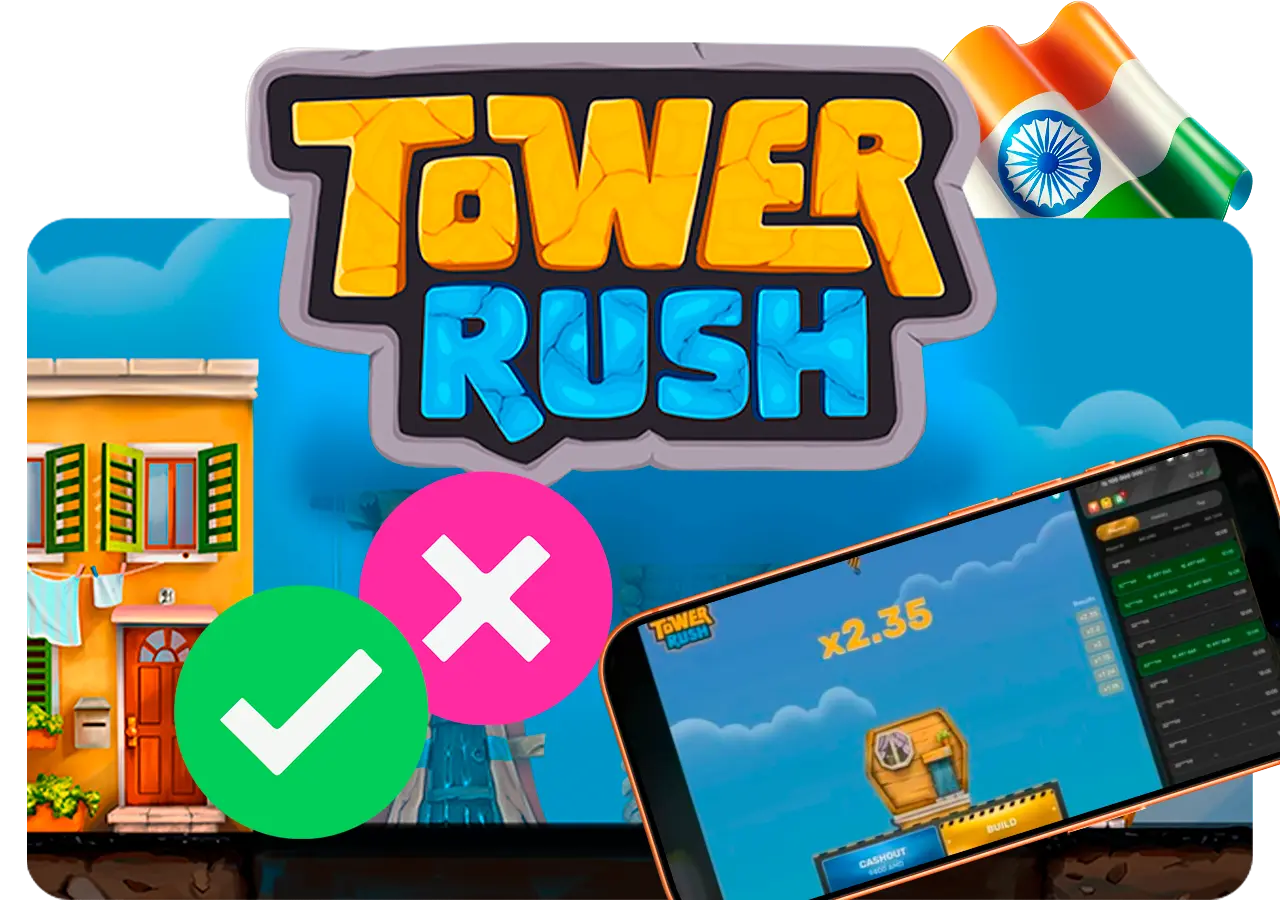
Advantages
- RTP in the range of 96.12% – 97%
- 3 bonus floors: Frozen Floor, Temple Floor, and Triple Build with increased multipliers
- Maximum win of ₹8,25,000
- Provable Fairness – complete transparency in game results
- Ability to play in demo mode without real money
Disadvantages
- Absence of a storyline or variety in gameplay
- Simple mechanics – nothing extra
- Full dependence on randomness – winnings cannot be predicted or calculated
- No control over the outcome after pressing the “Build” button
Despite the few drawbacks, the game remains engaging and appealing to fans of simple slots with fast results.
Is It Worth Playing?
Tower Rush is an exciting game with an average RTP ranging from 96.12% to 97%. This slot is considered one of the most rewarding games in the **Crash Games** genre. The possibility of winning up to ₹8,25,000 with a maximum bet of ₹8,300 attracts experienced players, while its simple mechanics make it suitable for beginners.
Main Advantages of the Slot:
- Ability to verify fairness using Provable Fairness.
- 3 bonus levels that affect the outcome: Frozen Floor, Temple Floor, and Triple Build.
- Betting range from ₹0.75 to ₹8,300 .
- Instant rounds with no long waiting times.
With moderate risk, the game offers a steady chance to win small amounts, and with aggressive play, you can aim for the highest multipliers. For gamblers who enjoy quick results, this title by **Galaxsys** is one of the best options in the fast-paced game category.
FAQ
What is the RTP of Tower Rush?
The game’s return to player (RTP) is variable and ranges from 96.12% to 97%.
Can I play for free?
Yes! A demo version is available, where you can place virtual coin bets. It mirrors the full game experience.
What is the minimum and maximum bet?
Players can bet from ₹0.75 to ₹8,300
What is the maximum possible win?
The jackpot in this slot is ₹8,25,000, which is 100x the maximum bet.
What determines the outcome of the game?
The outcome is entirely determined by the RNG, which can be verified through the Provable Fairness system.
Can I use strategies?
Yes, strategies can be used, especially in bankroll management. However, it’s important to understand that strategies do not guarantee a win.
Can I play on my phone?
Yes. The game works through browsers on Android, iOS, and Windows. No additional files are required to play.